Tuesday, July 24, 2012

NORELL ON-THE-TOWN PAISLEY

EMBROIDERED PAISLEY DESIGN ON NORMAN NORELL GOWN
MODELS IN MERMAID DRESSES SURROUND THE DESIGNER


Somehow, contemporary fashionistas mistakenly think that sexy was invented in years Madonna and post-Madonna.  I remember a student who thought that time was divided into Madonna and pre-Madonna, as in "Don't be such a pre-Madonna."  I have now added post-Madonna which like post-Modern, does not mean that Madonna and Modern are not important and influential, it just is that the world has sort of moved on.

But  the late American designer Norman Norell knew elegant sexy from the get-go and designed it for Hollywood stars like Gloria Swanson as well the east coast socialite of the late 40s, 50, 60s and into the 70s.  He is said to have invented the chemise, the dress that forgot its waistline.

Norell is shown here with a group of models wearing variations of his mermaid dress with its subtle train. This clingy siren gown did remember its waistline. The mermaid at the far right is embroidered with feminine paisleys. The photo is not dated but must be late 1960s or early 1970s.  And if Norell's paisley mermaid was around today, it would be definitely be going to the best parties this fall.  JP

Monday, July 2, 2012

American Flower Quilt

 AMERICAN FLORAL QUILT MOTIF WITH PAISLEY PETALS.


CLOSE-UP OF BLUE PAISLEY WITH JAGGED EDGES.

My first blog entry was the story of my mother's Aunt Flora who came one summer for an extended visit. Readers may remember that it was this woman who went shopping with me for a head scarf and selected a paisley  because "a paisley is always good."  She didn't, however,  have an answer for me when I asked  "What was a paisley?"

Aunt Flora had decided to make a floral patchwork quilt for my bed during her stay and had evidently worked out the pattern of almost 150 flowers with unrepeated floral print petals well before making the trip.  However, she waited until she got to Detroit to buy the fabric, with the help of my mother.

Her selection of floral prints and their corresponding solid color companions took place at a small, local fabric store,  I really can't remember where.  But I do remember that the job was done with great efficiency and speed. 

 In recent years, I have used the quilt as a bedcover, frequently studying the 1950's patterns -- never even hoped to find a paisley. Then on a recent day, there it was, blue with a jagged border and three little red dots as inside filling, rather conventional little flowers as companions and all against a white ground.  It seemed somewhat strange that there was only one paisley print.  Perhaps the postwar paisley trend was just coming into its own and hadn't filtered down to inexpensive cotton yard goods.

The discovery prompted the recollection of the importance of American quilting as historical documentation -- of a family, an era, the fabric industry.  From what was been observed, early American textiles were not the works of art that were produced in Europe and Asia at that time.  However, the craftswomenship of quilting and embroidery of the 18th and 19th centuries is outstanding and historically important.  One can look back at the milestone of the red-and-white quilt exhibit sponsored by the American Folk Art Museum in 2011, 650 quilts sensationally hung from the mile-high ceilings of the Park Avenue Armory.  There is also the crazy quilt genre that seems to have created a 1880s American fad after people saw the Japanese Exhibit in the 1876 Philadelphia Centennial Exposition.  And also of importance is the story of the "Underground Railroad Quilt Code" and the possibility that the display of these quilts offered messages for escaped slaves.

So, thank you Aunt Flora for the little paisley message that endures.  JP


Tuesday, June 5, 2012

A TENDER PAISLEY SAYS GOODBYE

When Raf Simons,  the talented Belgian creative director at Jil Sander, showed what happened to be his final Sander collection, he sent out a stand-out dress with fabric and over-weave of threads (fil de coupe) printed in an icy-yet-tender-neon paisley motif.  This for a label that is minimalist down to its bones. And yes, this little paisley seemed to send a message, maybe "I'm going to fly away." The dress and a few paisley companions were magazine features and were also displayed up center in a march of mannequins on the sales floor at Barney's New York. Jil Sander was to return to her namesake company next season round.

Shortly after the shows, the even bigger announcement came.  Simons was to become the new creative director of Dior.  And the "Fashion Chew" began with most fashionistas questioning Dior's decision. Was it a good fit? They named names they liked more than Simons. What would become of Dior?

A brilliant analysis by WWD's Miles Socha in the Fall 2012 Collections magazine spoke to today's role of creative director in fashion brand.  Socha is right, brand or image has all the power right now.  He selects a perfect quote from Karl Lagerfeld:  "It's my job to do the image of the companies, not to go on an ego trip." 

I cannot foretell what Simons will present for his first haute couture Dior collection this July but I am of the belief that both Dior and Simons are smart enough to stick to image with maybe a wink of what we saw with the neon paisley.  Simons seems to be all work and little ego.   

But isn't it interesting that the designer recruits the tender-but-powerful paisley to send his little side message?  JP    


The little paisley travels well.

Friday, April 6, 2012

WHEN IN ITALY...

Everybody buys a shawl in Bellagio.  Luckily, some are still made in Italy.

Two summer's ago, I stopped in Prato, anticipating that I would still be able to hear the hum of the textile weaving machines and perhaps visit the textile museum.  I had romantic visions of The Merchant of Prato still jaunting down the streets with his pockets stuffed full of sales orders.  My cab ride to the hotel near the train station should have been a tip-off.  The driver nearly wept as he told me how the Prato Italian industry was no more and its wonderful craftspeople were out of work.

Later on arrival day, going out to find a restaurant for dinner in the neighborhood of the hotel, I realized that I didn't want to be there at all and quickly decided to move on the following afternoon.  In the morning, I would visit Lorenzo de Medici's villa a couple of towns away and then leave Prato for the quiet of Fiesole.

By last summer, there were stories in  the New York Times and on National Public Radio about "fast fashion" that could be legally labeled "made in Italy" because it was.  Fabric was shipped into Prato from Asia and the workers were shipped into Prato as well.  The resultant product neither represented Italian quality or soul.  This past mid-March, there were reports that Italian critics who understood the textile industry finally spoke out about  the government's decision to support the country's mechanical industry at the sacrifice of textiles.

Other than the touristy shawl merchants of Bellagio and the high-end Etros and friends, there are few textile finds for the shopper who doesn't want the global designer labels that can easily be found in U.S. boutiques.  Later in the trip I would find some smashing scarves in a small Lucca boutique that all had French labels, one being hand-sewn and embroidered in India.  In Bologna, I would find an Italian-woven silk with the label of a UK designer.

Dear Prato, I wish I could make things better for you. Even Detroit is sort of developing its fashion industry. JP

Tuesday, March 20, 2012

A PAISLEY SONG FOR ORPHEUS

Orpheus Fountain at Cranbrook

Gloria Sachs, well known in the fashion world for the luxurious silk day separates that bore her label (1970 to 1994) and were worn by a large, loyal contingent of American women who shopped at the finest specialty stores, died March 12.  Her knowledge and passion for textile design were an inspiration, in particular the perfectly engineered paisley patterns she created and printed at the Ratti facilities in Como, Italy. She may well have been the first fashion designer to incorporate the acanthus leaf pattern with the paisley.

She studied textile design at the Cranbrook Academy of Art, Bloomfield Hills, Mich., and described her student days, sitting around the school's Orpheus fountain with famous Cranbrook artists, architects and fabric and furniture designers who would soon change the course of mid-century American design.  "I thought all of life would be like that," she confessed one day. She went on to design fabric for Hans Knoll and Herman Miller and some of those textiles are in the Museum of Modern Art.  This was to be just one of her many honors throughout a long and giving career.

Certainly the work Sachs did at Antonio Ratti's studio with windows facing the lake, her own paintings and sculptures that were widely exhibited, her association with the Chinese artist Xu Bing and her proposed Beijing trip as a visiting scholar scheduled for fall, represented the beauty and delight that would please Orpheus.

Personally I like to visualize the piercing intelligence and talent and endless energy of an ageless Gloria Sachs sitting in the warm spring sun at the Cranbrook Fountain, the masterwork of sculptor Carl Milles, saying "Yes, after all,  life is like that."  JP

Gloria Sachs' paisley fashion sketch probably from the 1980s

Wednesday, January 18, 2012

IS THAT A BOTEH ON YOUR TURBAN?

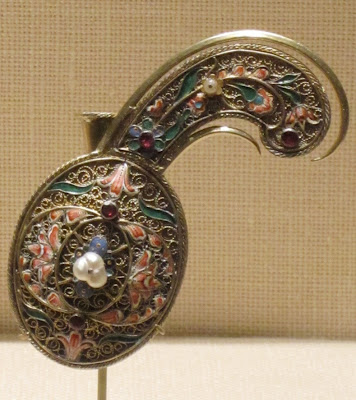
QAJAR PERIOD (1779-1925) 19TH CENTURY SILVER ORNAMENT


The New Galleries for the Art of the Arab Lands at The Metropolitan Museum of Art are not overrun with examples of the boteh or paisley motif, but what is found is outstanding. As with the Mughal flask of last post, I was onto a needle-in-a-palace search, this time for an 19th-century silver turban ornament from Iran's Qajar period, a richly gilded and wire-filigree patterned oval with applied enamels,  a pearl center and a boteh on top.

The area's small Edward C. Moore Collection room had been first overlooked in the walk round and round.  There are several rooms for private collections, each with its own door.  And the Moore Collection houses one of them.  Mr. Moore, a 19th-century New Yorker, had been the owner of the ornament.

It seems that all kinds of important men have worn some style of head wrap over the ages to set themselves apart from commoners.  A power look in Renaissance Florence appears to have included the loosely-tied head coverings certain well-connected men threw on for profile portraits that are now on display in another of the Met's second-floor exhibits.  The princes of the church had their full vocabulary of miters with trailing streamers and beanies. And the Arab royals had their perfect turbans, many times with head ornaments that held  big, fluffy feathers that tended to curl into the boteh shape at the top of royal heads.

It could be conjectured that because of 15th-century Florence's interest in eastern textiles, scholarship and culture,  the Renaissance capital had been loving the head-wrap look.  But it was the Arab regal who would have won the Global Style Award for his perfectly wrapped turban topped with a beautiful ornament and maybe an attention-getting feather bobbing ever so slightly as he spoke. JP

Tuesday, January 3, 2012

MUGHAL MAGIC AT THE NEW MET GALLERIES

In the mid 17th century, this flask was made for a Mughal and 
decorated with a motif including emerald boteh.


A Dec. 27 Wall Street Journal story headlined "The Year's Best Arts Adventure" told me a few things I hadn't considered. There are 1,200 objects on view at the New Galleries for the Art of the Arab Lands, Turkey, Iran, Central Asia and Later South Asia that opened in November at the Metropolitan Museum of Art. And that these galleries have a collection of 12,000 objects to show us over time, enough to be a museum all its own.

Approaching the museum recently, I was entranced by a huge poster photo on one of its advertising kiosks. There was this giant Mughal flask covered with rich dots of rubies and enamels, traceries of gold and yes, the most perfect emeralds carved into boteh or teardrop motifs. Once inside the exhibit, it became my focused mission to locate that flask which turned out to be maybe seven inches tall at most.

One could marvel the whole afternoon at the gentle rock crystal carved into a mango shape and detailed with the probably-impossible-to-duplicate design fit for a Mughal emperor. I wondered what the owner carried in his flask-- an essence for fragrance or for his health? A clear liquid essence might turn the magical design into a variety of patterns at each new perspective, in each kind of light. I would think that candlelight would be best. The mango shape would be soft in the hand and reminiscent of the beloved boteh, sometimes referred to as a mango motif. The museum signage places the Mughal period from 1526 to 1858 and the flask at mid 17th century.

Whoever that Mughal owner was, I am sure he was an even finer person whenever he looked at his exquisite flask, and if he was anything like Akbar The Great, (1542 to 1605), perhaps humbled by its great artistry. JP